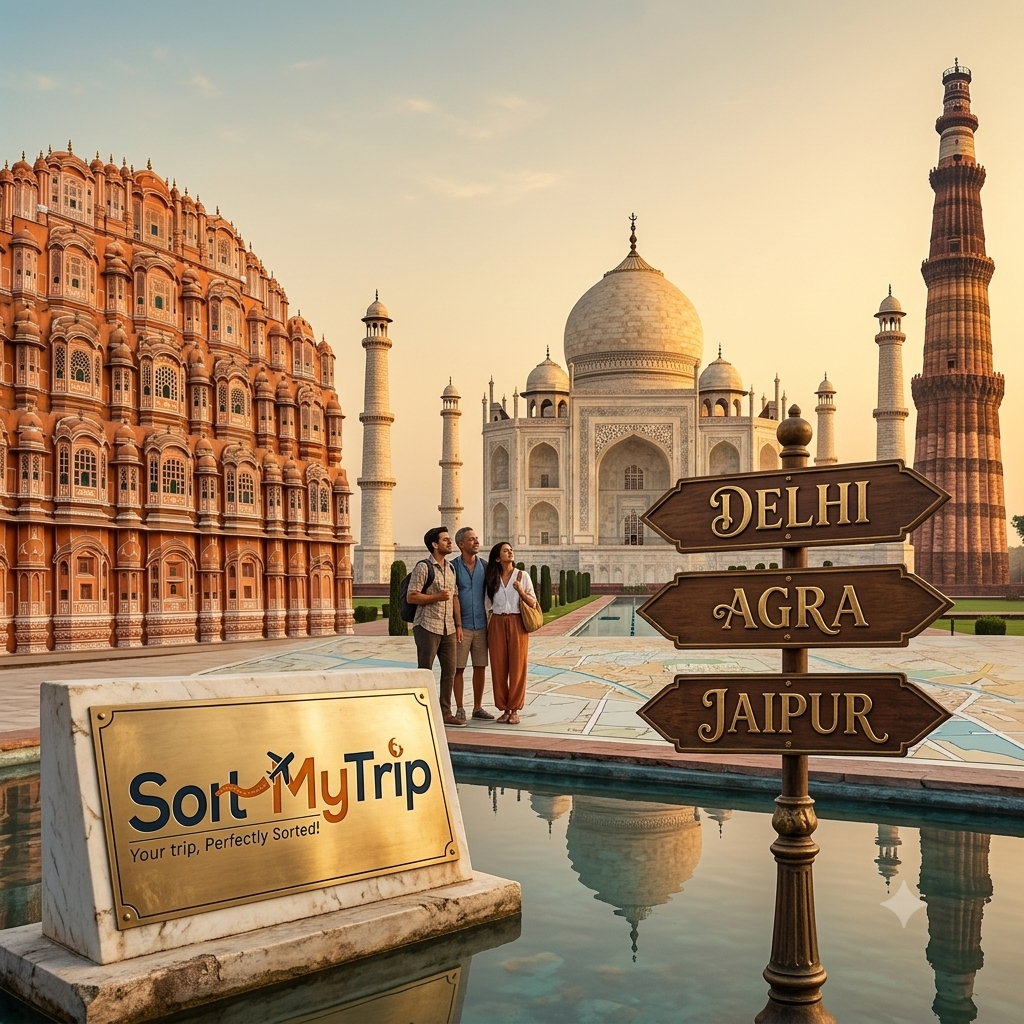
An incredible introduction to the vibrant tapestry of India comes alive in a single, classic travel route: the Golden Triangle. Connecting the country’s capital, Delhi, with the romantic Mughal heritage of Agra and the regal majesty of Jaipur, this circuit forms a geometric and cultural triangle across northern India. For first-time international visitors and domestic explorers alike, it serves as the ultimate gateway to experiencing centuries of history, architectural masterclasses, and sensory overloads in the most memorable way.
Planning an adventure of this magnitude can feel overwhelming with endless transportation choices, ticket queues, and routing variables. That is exactly where Sort My Trip steps in to handle your end-to-end travel logistics, curating customized travel packages that align seamlessly with your style and budget. Here is your definitive, professional, 2000-word first-timer’s guide to navigating the ultimate Golden Triangle India itinerary.
Understanding the Golden Triangle Circuit
Before diving into the day-by-day flow, it helps to understand what makes this specific route so iconic. The circuit covers approximately 720 kilometers on the ground. Each corner of the triangle presents a completely unique facet of India’s historical identity:
Delhi represents the convergence of eras, where the chaotic, narrow trading alleys of the Mughal past sit directly alongside grand, tree-lined British colonial boulevards.
Agra stands as the timeless epicentre of Mughal artistry, housing the world's most famous monument to eternal love alongside colossal defensive bastions.
Jaipur, the flamboyant capital of Rajasthan, introduces you to the world of Rajput warriors, opulent hilltop forts, and meticulously planned pastel-hued bazaars.
By organizing your journey systematically through these three urban hubs, you get a front-row seat to the evolution of Indian civilization, art, and governance across a single week.
When to Plan Your Journey
Timing your trip properly ensures you can comfortably explore outdoor fortresses and walk through bustling markets without being slowed down by extreme weather.
October to March is universally considered the peak season. During these cooler winter months, daytime temperatures range between a pleasant 15 degrees Celsius and 28 degrees Celsius. This is the prime window for extensive sightseeing, photography, and exploring open courtyards comfortably.
April to June brings the intense North Indian summer, where temperatures regularly exceed 40 degrees Celsius. While sightseeing requires a slower pace and plenty of hydration, it is an excellent time for budget-conscious travellers to access premium luxury heritage stays at a fraction of their peak-season rates.
July to September ushers in the monsoon rains. The landscape transforms into a rich, vibrant green, and popular tourist monuments face far lower crowd densities, offering a highly atmospheric and visually unique perspective for photography.
The Ultimate 7-Day Day-by-Day Itinerary
To truly absorb the cultural depth of these destinations without facing travel fatigue, a 6 to 7-day timeline provides the most balanced and rewarding pace.
Day 1: Welcome to Delhi – The Grand Confluence of Eras
Your Indian expedition officially begins upon your arrival at Indira Gandhi International Airport in Delhi. Stepping out into the city, you will instantly feel the kinetic energy of a capital that houses nearly 30 million people while serving as a living museum.
Dedicate your opening afternoon to exploring New Delhi's wide, imperial avenues designed by Sir Edwin Lutyens during the early 20th century. Begin with a drive past the majestic Rashtrapati Bhavan, the official residence of the President of India, flanked by the architectural symmetry of the Parliament buildings. Stop to walk along the sweeping lawns of India Gate, a towering 42-meter-high stone memorial arch dedicated to the fallen soldiers of the British Indian Army.
As the late afternoon sun softens, head toward Humayun’s Tomb. This magnificent structure is a UNESCO World Heritage site and a brilliant example of early Mughal garden-tomb design. Built in 1570, its grand double dome, clean geometric lines, and red sandstone masonry served as the primary architectural blueprint and inspiration for the Taj Mahal decades later. Conclude your evening with an upscale, authentic North Indian dinner in the vibrant commercial lanes of Connaught Place or Khan Market, sampling rich delicacies like slow-cooked dal makhani and aromatic butter chicken.
Day 2: Old Delhi Heritage and Culinary Immersion
Wake up early to immerse yourself completely in the historic heart of Old Delhi, originally known as Shahjahanabad when it was established by Mughal Emperor Shah Jahan in 1639. The transition from New Delhi’s wide avenues to the high-density vibrancy of the old quarter is a thrilling sensory shift.
Start your exploration at the iconic Red Fort, or Lal Qila, standing before its massive sandstone defensive walls that extend for over two kilometers. Next, make your way to the grand courtyard of Jama Masjid, one of the largest mosques in India. Capable of holding more than 25,000 worshippers, climbing its southern minaret offers an unparalleled panoramic view over the sea of roofs across the old city.
From the steps of the mosque, board a classic cycle rickshaw to dive deep into the labyrinthine alleys of Chandni Chowk. This historic trading marketplace is divided into specialized avenues: Khari Baoli, which stands as Asia's largest wholesale spice market, fills the air with the sharp aroma of ground chilis, turmeric, and cardamom, while Dariba Kalan sparkles with centuries-old silver craft and handcrafted ittar, or traditional botanical perfumes.
No trip to this quarter is complete without exploring its legendary street food ecosystem. Make a dedicated stop at the historic Paranthe Wali Gali to watch third-generation cooks fry hot, stuffed flatbreads filled with everything from paneer to spiced potatoes, served with tangy tamarind chutneys.
In the afternoon, travel to the southern edge of the city to see the Qutub Minar complex. Towering at 73 meters, this 12th-century victory tower is the tallest brick minaret in the world, covered in intricate calligraphic carvings. It marks the historical transition into the Delhi Sultanate era.
Day 3: Travel to Agra – Discovering the Fortresses of the Mughals
On your third morning, leave the capital behind and journey southeast toward Agra. Travelling via the modern, smooth Yamuna Expressway ensures a swift and comfortable transit of roughly 3 to 4 hours.
Upon entering Agra, check into your accommodation and head out directly to discover the formidable Agra Fort, a massive red sandstone fortress-city that served as the primary seat of power for successive Mughal emperors including Akbar, Jahangir, and Shah Jahan. As you walk through the majestic Amar Singh Gate, explore the sprawling courtyards, the opulent Mirror Palace, and the deeply poignant Musamman Burj. This octagonal marble tower is the exact location where Emperor Shah Jahan was imprisoned during his final years by his ambitious son, Aurangzeb, spending his days gazing across the river at his ultimate architectural creation.
As evening approaches, skip the crowded immediate monument gates and cross the Yamuna River to the tranquil grounds of Mehtab Bagh, the Moonlight Garden. Aligned perfectly with the northern face of the Taj Mahal, these manicured lawns offer a serene, unobstructed vantage point to watch the white marble change colours from soft orange to deep violet as the sun sets over the riverbank.
Day 4: The Sunrise Taj Mahal and the Road to the Pink City
Set an early alarm for a pre-dawn departure to experience the Taj Mahal at its most magical moment: sunrise. Entering the eastern or western gates at 5:30 AM allows you to beat the heavy midday tour crowds and see the morning light gradually illuminate the pure white Makrana marble.
Built by Shah Jahan as a mausoleum for his favorite wife, Mumtaz Mahal, the monument is a masterclass in flawless symmetry, stone engineering, and emotional storytelling. Observe the remarkable details up close, noting the delicate pietra dura inlay work where precious gemstones like jasper, lapis lazuli, and jade are embedded smoothly into the marble faces to create intricate floral patterns.
After returning to your hotel for breakfast and checking out, begin your road journey toward Jaipur. Approximately 40 kilometers outside Agra, make a vital stop at Fatehpur Sikri. This short-lived imperial capital was constructed entirely from red sandstone by Emperor Akbar in the late 16th century and abandoned just years later due to water shortages. The preservation of its palaces, the sprawling imperial court, and the towering 54-meter Buland Darwaza gate makes walking through it feel like stepping into a frozen moment in time.
Continue your drive into Rajasthan, arriving in Jaipur by late afternoon. The city earned its moniker, the Pink City, in 1876 when Maharaja Sawai Ram Singh ordered the entire old city painted in a distinct terracotta-pink hue to welcome Britain's Prince of Wales. Arrive in time to enjoy a traditional Rajasthani dinner, featuring classic local dishes like dal baati churma and spiced laal maas.
Day 5: Jaipur’s Royal Palaces and Cosmic Observatories
Dedicate your fifth day to exploring the architectural brilliance of the Kachwaha Rajput dynasty. Begin your morning just north of the city at the Amber Fort, an imposing hilltop fortress constructed from yellow and pink sandstone mixed with white marble. The climb up to the main courtyard reveals a spectacular defensive exterior that gives way to stunningly delicate interior spaces. Explore the breathtaking Sheesh Mahal, the Palace of Mirrors, where the walls are entirely covered in thousands of convex glass pieces imported from Belgium, designed to illuminate an entire hall with the flicker of a single candle.
On your drive back into the city center, pause at the edge of Man Sagar Lake for a scenic photo stop at the Jal Mahal, a poetic water palace that appears to float serenely on the calm surface, with four of its five stories completely submerged beneath the water.
By afternoon, explore the heart of the historic walled city at the City Palace complex, which remains the official residence of Jaipur’s titular royal family. Walk through its museums displaying royal vestments, ancient weaponry, and the iconic silver vessels certified as the largest single silver objects in the world.
Directly adjacent sits Jantar Mantar, a UNESCO-listed astronomical observatory built by the astronomer-king Maharaja Sawai Jai Singh II in 1734. The site features 19 massive architectural stone instruments, including the world’s largest stone sundial, which can calculate local time with an incredible accuracy of within two seconds.
Conclude your sightseeing loop directly in front of the iconic facade of the Hawa Mahal, the Palace of Winds. Built in 1799, this unique five-story structure features 953 small, honeycombed windows covered in delicate latticework. It was designed specifically to allow royal women to observe the vibrant street festivals below without being seen by the public, while letting cool air circulate naturally throughout the interior during the hot summer months.
Day 6: Artisan Villages and the Vibrant Bazaars of Rajasthan
Spend your final full day engaging with the living heritage and artistic traditions that make Rajasthan a global capital for traditional handicrafts. Start your morning with an excursion to a block-printing workshop in the nearby artisan clusters of Sanganer or Bagru. Here, you can watch local craftsmen use hand-carved teakwood blocks coated in natural plant-based dyes to stamp intricate geometric patterns onto cotton textiles with incredible precision.
Return to Jaipur’s old walled city to navigate its famous thematic bazaars. Spend a few hours exploring Bapu Bazaar, celebrated for its premium cotton textiles, traditional block-printed linens, and authentic camel-leather mojari shoes. Next, wander into Johari Bazaar, a world-famous hub for glittering gemstones, fine jewelry, and intricate lac bangles handmade directly on-site.
For your final evening, head to the rugged ridges of Nahargarh Fort, perched high on the Aravalli hills. Sitting along the stone ramparts with a refreshing beverage provides an unmatched view as the entire grid-planned layout of Jaipur lights up below you in the night air.
Day 7: Return Journey and Final Departures
After a relaxed breakfast at your hotel, begin the 5-hour drive back along the national highway connecting Jaipur to New Delhi. If your schedule permits, make a quick stop at the Patrika Gate at Jawahar Circle, an incredibly colorful, multi-arched gateway showcasing vibrant hand-painted murals that depict the distinct history of the various regions of Rajasthan.
Your private vehicle will transfer you directly to New Delhi's international airport or your preferred train station, bringing an unforgettable, culturally enriching week through India's historical heartland to a close.
Essential Packing and Cultural Etiquette Tips
To ensure a smooth, respectful, and safe journey, keep these key operational and cultural guidelines in mind:
-
Dress Modestly: When visiting religious spaces such as mosques, temples, and gurudwaras, keep your shoulders and knees covered. Always carry a light scarf in your daypack to cover your head when required.
-
Remove Shoes: Always take off your footwear before entering the main inner sanctuaries of temples, mosques, and historical tomb structures. Most major sites provide secure shoe-check counters or disposable cloth shoe-covers.
-
Stay Safely Hydrated: Rely strictly on sealed, branded bottled water or treated water available at premium hotels throughout the route. Avoid ice cubes in smaller roadside establishments.
-
Carry Small Currency Denominations: While digital payments and cards are widely used in premium stores, keeping small cash notes handy is essential for rickshaw rides, tipping, and purchasing local street snacks.
-
Respect Photography Restrictions: Certain heritage sites, particularly the interior of Akshardham Temple and the main interior tomb chamber of the Taj Mahal, enforce absolute bans on photography and mobile devices. Always verify signage at the gate.
Plan Your Golden Triangle Tour with Sort My Trip
Navigating three of India's most high-energy, historically dense cities requires meticulous logistical planning to keep your vacation stress-free. Sort My Trip eliminates the stress of coordinating local details, transforming your dream route into a smoothly sorted, premium reality.
Whether you are looking for a budget-friendly journey utilizing India's efficient express trains, a balanced mid-range family holiday, or an ultra-luxury heritage palace tour, Sort My Trip creates fully customized travel packages tailored specifically to your group size, travel dates, and personal interests. From organizing seamless airport pickups and securing experienced, licensed local history guides to booking premium, handpicked accommodations and providing clean, climate-controlled private vehicles with professional drivers, every single asset of your trip is managed end-to-end.
With transparent pricing, flexible booking terms, and dedicated 24/7 support throughout your entire journey, you can fully lose yourself in the magic of the Taj Mahal and the vibrant energy of Delhi's bazaars. Get in touch with the expert itinerary designers at Sort My Trip today to get your custom tour quotation, and prepare to embark on the ultimate journey through the timeless heart of India.