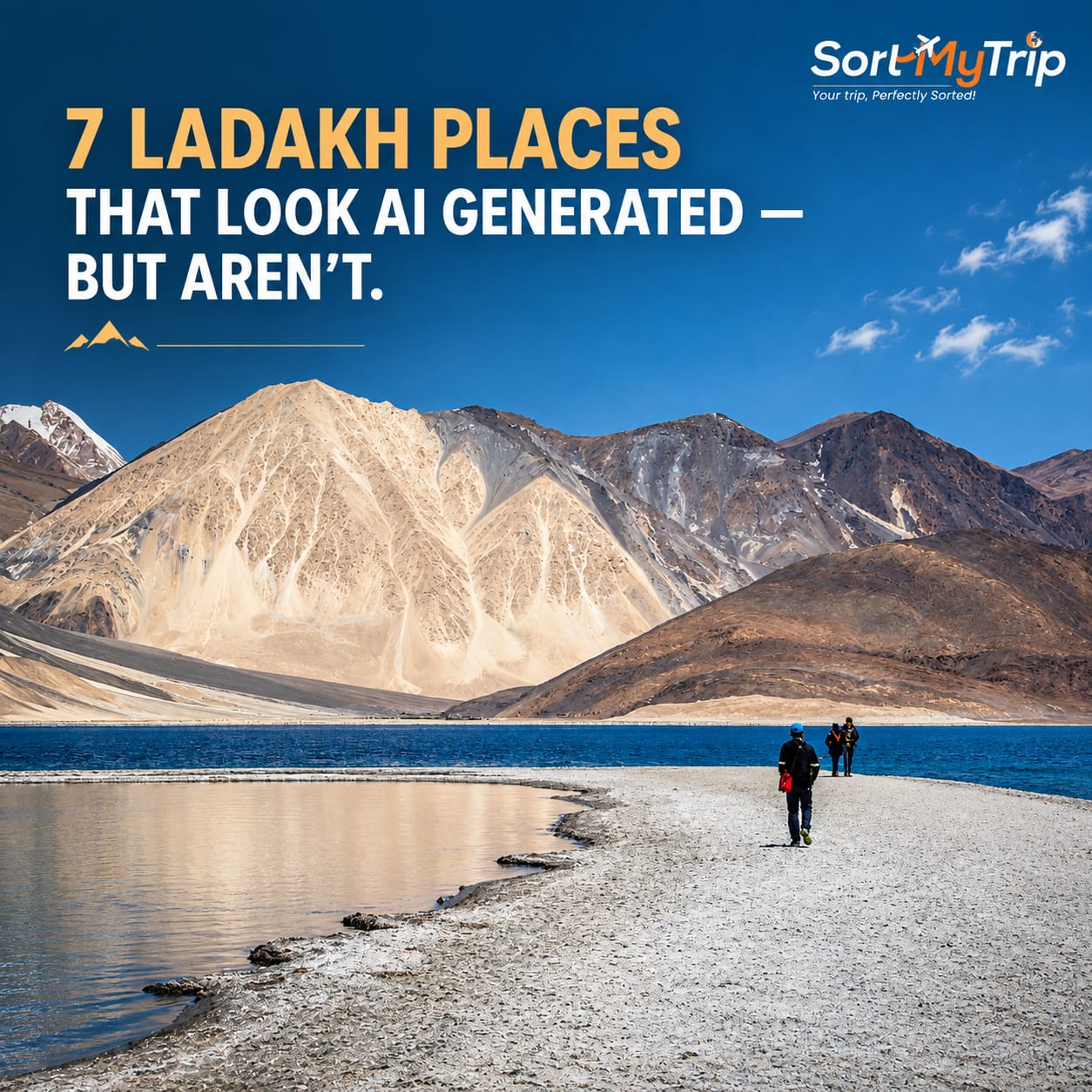
7 Ladakh Places That Look AI-Generated but Aren’t
Ladakh has a way of making reality look unbelievable.
A perfectly blue lake surrounded by barren mountains. A road disappearing into a valley of impossible colours. White sand dunes sitting beneath towering Himalayan peaks. Ancient monasteries perched dramatically above landscapes that seem almost too perfect to be real.
Scroll through photographs of Ladakh and you might assume some of them have been heavily edited or even created using artificial intelligence.
But many of these landscapes are completely real.
The combination of high-altitude deserts, glacial lakes, dramatic mountain ranges, unusual rock formations and crystal-clear skies makes Ladakh one of the most visually extraordinary destinations in India.
If you are planning a trip to the region, here are 7 Ladakh places that look AI-generated but actually exist in real life.
1. Pangong Lake – The Blue That Doesn't Look Real
Perhaps no place represents surreal Ladakh better than Pangong Lake.
Located at a high altitude in the Changthang region, Pangong is famous for its striking blue waters surrounded by rugged mountains.
The lake can appear to change colour depending on the light, weather and viewing conditions.
One moment it can look deep blue.
A few hours later, the same landscape can appear turquoise or grey.
What makes Pangong particularly extraordinary is the contrast between the bright water and the almost completely barren mountains surrounding it.
There are very few trees around the lake, which makes the colours and scale of the landscape even more dramatic.
And yes, those photographs of the incredibly blue lake are real.
Best experience: Arrive early, walk quietly along the shore and watch the changing colours of the water.
Travel tip: Weather at high altitude can change quickly, so keep warm clothing with you even during warmer months.
2. Nubra Valley – A Desert Beneath Himalayan Peaks
A desert in the middle of the Himalayas sounds like something created by AI.
But Nubra Valley is very real.
The valley is famous for its combination of dramatic mountains, green villages, rivers and stretches of high-altitude desert.
One of the most surprising landscapes can be seen around the Hunder area, where sand dunes appear beneath enormous Himalayan mountains.
It feels almost impossible that you can find sand dunes at such an altitude with snow-covered peaks in the distance.
The contrast is what makes Nubra so visually special.
You can go from rocky mountain landscapes to green agricultural areas and then to sand dunes within the same broader valley.
Best experience: Spend at least one night in Nubra instead of treating it as a quick stopover from Leh.
Travel tip: Keep some time for village walks and local experiences rather than visiting only the famous dunes.
3. Tso Moriri – A Lake in the Middle of Nowhere
If Pangong is the famous Ladakh lake, Tso Moriri is its quieter and more remote counterpart.
Located in the Changthang region, Tso Moriri is surrounded by mountains and vast open landscapes.
The first impression is often one of complete isolation.
There are no big cities, crowded streets or urban buildings dominating the horizon.
Just water, mountains, sky and enormous stretches of open land.
The colours can be spectacular, particularly when sunlight hits the lake and surrounding slopes.
Because of its remote setting, Tso Moriri can feel even more surreal than some of Ladakh's better-known attractions.
Best experience: Spend a night near the lake and experience the landscape around sunrise and sunset.
Travel tip: Check current road conditions and local travel requirements before planning a visit, as conditions in remote high-altitude areas can change.
4. Magnetic Hill – The Road That Plays Tricks on Your Eyes
Not every strange-looking Ladakh experience involves a lake.
On the Leh–Srinagar route, Magnetic Hill has become one of Ladakh's most talked-about roadside attractions.
The area is famous for an optical illusion that can make vehicles appear to move uphill when placed in a particular position.
The landscape itself also adds to the experience.
You are surrounded by enormous barren mountains and an almost completely open horizon.
Whether you are fascinated by the phenomenon or simply want to stop for photographs, it is an unusual part of a Ladakh road trip.
The important thing to remember is that the apparent uphill movement is generally explained by an optical illusion created by the surrounding landscape rather than actual magnetic forces pulling vehicles.
Best experience: Stop safely at the designated area and enjoy the landscape rather than treating the spot only as a quick photograph.
Travel tip: Never stop your vehicle in an unsafe position on the highway simply for a photograph.
5. Lamayuru – The Moonland of Ladakh
Few landscapes in Ladakh look as unusual as Lamayuru.
The region is famous for its deeply eroded mountains and unusual geological formations.
The landscape has a rugged, almost lunar appearance, which has led to Lamayuru being popularly associated with the nickname “Moonland.”
The combination of pale, sculpted mountains and the ancient Lamayuru Monastery makes the area especially striking.
From certain viewpoints, the terrain genuinely looks like another planet.
But there is no artificial landscape involved.
It is the result of natural geological processes acting over a very long period.
Best experience: Take time to explore the monastery and surrounding landscape rather than stopping only for a roadside photograph.
Travel tip: Lamayuru is located on the Leh–Srinagar route, making it a natural addition to a road journey between Leh and the Kashmir side.
6. Zanskar Valley – Where the Mountains Take Over
For travellers looking for landscapes that feel genuinely otherworldly, Zanskar Valley deserves a place on the list.
The region is known for dramatic mountain terrain, deep valleys, remote villages and rivers cutting through the Himalayan landscape.
The scale can be difficult to understand from photographs.
Massive mountains rise around narrow valleys, while roads and rivers appear tiny in comparison.
During different seasons, the landscape can look completely different.
Summer reveals green patches and flowing rivers, while winter transforms parts of the region into a dramatically frozen landscape.
This is one of those places where photographs can look edited simply because the real landscape is already so extreme.
Best experience: Take the journey slowly and spend time experiencing the villages and landscapes along the route.
Travel tip: Zanskar involves remote and challenging travel conditions. Plan your route carefully and check current road accessibility before travelling.
7. Tso Kar – Ladakh's High-Altitude Salt Lake Landscape
Often overshadowed by Pangong and Tso Moriri, Tso Kar offers another spectacular side of Ladakh's high-altitude landscape.
Located in the Rupshu region, Tso Kar is known for its salt-encrusted surroundings, dramatic mountains and stark open terrain.
The area feels almost completely untouched.
Depending on the season and conditions, you may see contrasting shades of white, brown, blue and green across the landscape.
The combination of lake, mountains and vast empty surroundings gives the region an almost digitally created appearance.
But this is one of Ladakh's real natural landscapes.
Best experience: Take time to observe the surrounding landscape and wildlife rather than rushing through the area.
Travel tip: Tso Kar is remote and situated at high altitude, so proper acclimatisation and careful planning are important.
Why Does Ladakh Look So Unreal?
There is a simple reason photographs from Ladakh can look almost artificial.
The region combines several landscapes that rarely appear together in one destination.
You can find:
High-altitude lakes
Barren mountains
Snow-covered peaks
Sand dunes
Green river valleys
Ancient monasteries
Dramatic rock formations
Vast open skies
High mountain passes
The lack of dense vegetation in many areas also creates incredibly clear visual contrasts.
Blue water against brown mountains.
White snow against dark rock.
Green fields surrounded by barren slopes.
Golden sand beneath Himalayan peaks.
These natural contrasts make Ladakh look almost too perfect for a photograph.
The Best Part? You Don't Need an AI Filter
One of the biggest attractions of Ladakh is that you can see many of these landscapes with your own eyes.
Of course, photographs can change colours depending on camera settings, lighting and post-processing.
But the basic landscapes are real.
That is what makes travelling through Ladakh so rewarding.
You are not simply looking at a beautiful photograph.
You are standing inside it.
When Is the Best Time to See These Landscapes?
The ideal travel period depends on the specific area and current road conditions.
For most conventional Ladakh road trips, the warmer months are generally the most accessible.
Summer brings open roads, flowing rivers, green patches around villages and accessible high-altitude lakes.
The landscape can look particularly dramatic around sunrise and sunset when the changing light creates strong shadows across the mountains.
Winter is a completely different experience.
Snow and freezing temperatures transform the region, and some routes become inaccessible.
Before travelling, always check current road conditions, permits, weather and local travel advisories.
How to Photograph Ladakh Without Making It Look Fake
You do not need heavy editing to capture the beauty of Ladakh.
Try photographing during early morning or late afternoon when the light is softer.
Keep some foreground elements in your photographs to show the enormous scale of the mountains.
Avoid over-saturating the colours.
Let the natural contrast between the landscape elements do the work.
And most importantly, take some photographs with your phone or camera away.
Some landscapes are better experienced than photographed.
A Few Things to Remember Before Your Ladakh Trip
Ladakh is beautiful, but it is also a high-altitude destination.
Give your body time to acclimatise after arriving.
Stay hydrated and avoid overexertion during the first few days.
Carry warm layers because temperatures can change quickly.
Road conditions can change due to weather, construction and other local factors, particularly in remote areas.
Always follow local advice and avoid travelling to restricted or unsafe areas.
Final Thoughts
Ladakh does not need artificial intelligence to create extraordinary landscapes.
Nature has already done the work.
From the impossible blue of Pangong Lake to the desert landscapes of Nubra, the moon-like terrain around Lamayuru and the remote beauty of Zanskar, the region is full of places that challenge your idea of what a real landscape should look like.
And perhaps that is what makes Ladakh so special.
You can see a photograph online and think:
“There is no way this is real.”
Then you arrive.
And realise it is.
Let SortMyTrip Help you with this curated package, from comfortable stays and carefully planned routes to local sightseeing and high-altitude travel planning.
Because Ladakh is not just a destination you photograph.
It is a landscape you have to experience.
Frequently Asked Questions
1. Which place in Ladakh looks the most unreal?
Pangong Lake is perhaps the most recognisable example because of its dramatic blue water and surrounding barren mountains. However, Nubra Valley, Lamayuru, Tso Moriri and Zanskar are equally impressive in their own ways.
2. Is Pangong Lake actually as blue as it looks in photographs?
Yes, Pangong Lake can display striking blue and turquoise tones. The exact appearance varies depending on sunlight, weather and viewing conditions.
3. Why is Lamayuru called Moonland?
Lamayuru is popularly called Moonland because of its unusual, heavily eroded terrain, which can resemble a lunar landscape from certain viewpoints.
4. Is Nubra Valley really a desert?
Nubra contains high-altitude desert landscapes, including sand dunes around Hunder, despite being surrounded by the Himalayan mountains.
5. Is Tso Moriri better than Pangong Lake?
Neither is objectively better. Pangong is more famous and easier to include in many standard itineraries, while Tso Moriri offers a quieter and more remote experience.
6. Can beginners travel to Ladakh?
Yes, but Ladakh requires proper acclimatisation and preparation because of its high altitude. A well-planned itinerary is particularly important for first-time visitors.
7. Are these Ladakh landscapes edited or AI-generated?
The locations and landscapes are real. However, individual photographs may be edited for exposure, contrast, colour or saturation, so the exact appearance of a photograph can vary from what you see in person.
8. How many days should I spend in Ladakh?
A trip of around 6 to 10 days can cover several major destinations, depending on your route. Longer trips allow more time for acclimatisation and remote areas such as Zanskar or Tso Moriri.
9. What should I carry for a Ladakh trip?
Warm layers, sunglasses, sunscreen, comfortable footwear, basic medicines, personal essentials and adequate water are important. For road trips, it is also sensible to carry a basic puncture/vehicle emergency kit and other practical travel essentials.
10. Can Sort My Trip customise a Ladakh itinerary?
Yes. Your Ladakh trip can be customised according to your preferred duration, accommodation, vehicle, sightseeing priorities and destinations.
.jpeg)