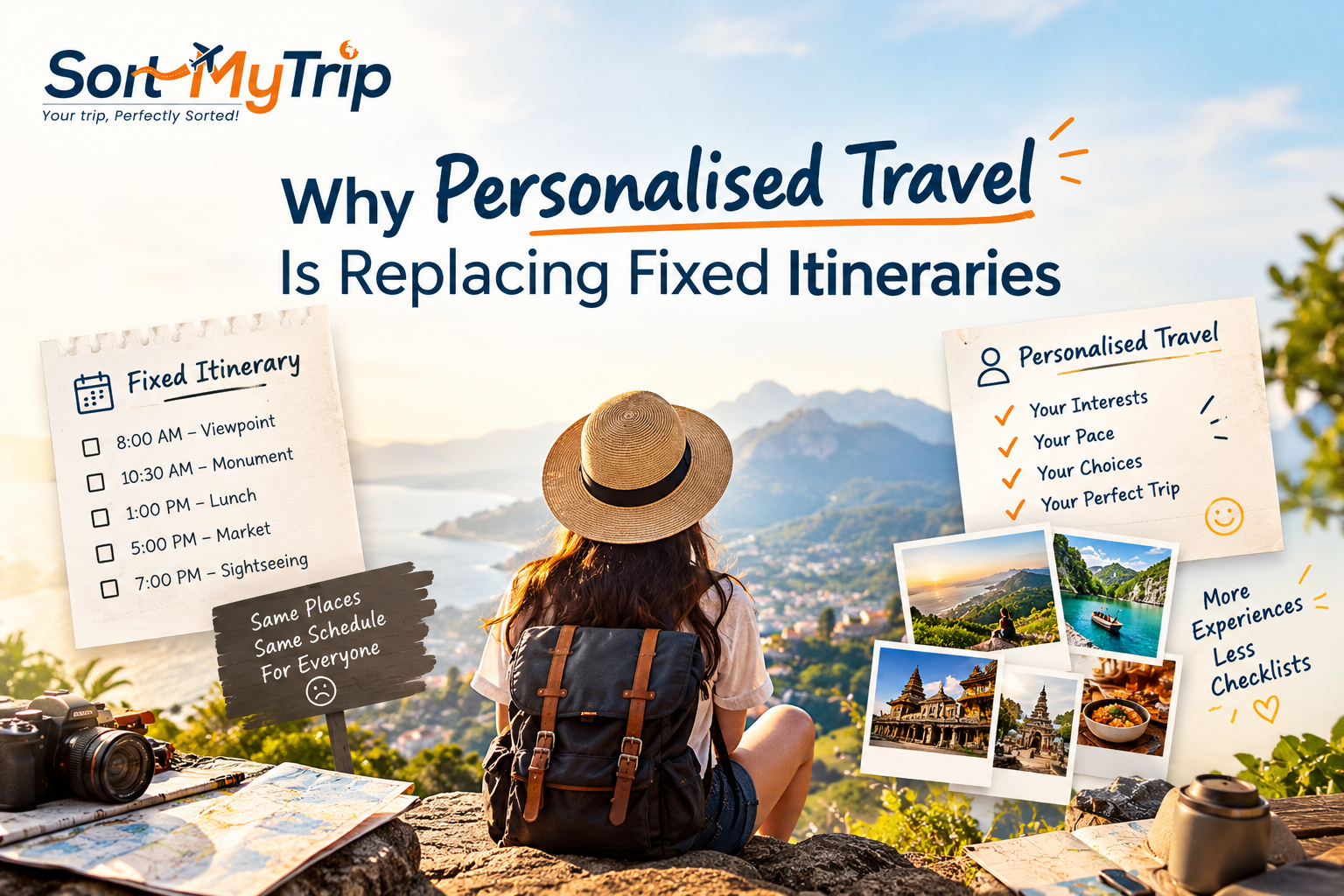
Why Personalised Travel Is Replacing Fixed Itineraries
The Itinerary Looked Perfect. Until the Traveller Arrived.
It had everything.
A famous viewpoint at 8:00 AM.
A monument at 10:30.
Lunch at 1:00.
A market in the evening.
And another sightseeing stop before dinner.
On paper, the itinerary looked perfect.
But travel rarely happens on paper.
The traveller wanted to spend more time at the viewpoint. A local recommended a café that wasn't included in the plan. Traffic made the journey longer than expected. By afternoon, the excitement of sightseeing had quietly turned into a race against the clock.
Nothing was technically wrong with the itinerary.
It simply wasn't their itinerary.
This is one of the reasons personalised travel planning is becoming increasingly important in modern tourism.
Travellers are no longer asking only:
"Where should I go?"
They are also asking:
"How do I want to experience it?"
What Is Personalised Travel?
Personalised travel means creating a trip around the traveller instead of asking the traveller to fit into a predetermined package.
Traditional travel planning often follows a simple structure:
Destination → Hotel → Sightseeing → Transport
Personalised travel starts somewhere else: with the traveller.
What do they enjoy?
How quickly do they like to travel?
Who are they travelling with?
What is their budget?
Do they prefer adventure, relaxation, culture, food, nature or a combination of different experiences?
The answers can influence everything from accommodation and transportation to activities, sightseeing and the overall pace of the trip.
Personalised travel is also commonly described as tailor-made travel, customised travel or bespoke travel planning.
The destination remains important.
But the traveller becomes the starting point.
Fixed Itineraries vs Personalised Itineraries
Fixed itineraries are not disappearing completely.
They continue to be useful for travellers who prefer predictable schedules, standard sightseeing and straightforward travel packages.
The difference is that modern travellers increasingly have more choices when planning their holidays.
A fixed itinerary generally includes:
Pre-decided destinations
Standard sightseeing
Fixed timings
Pre-selected hotels
Limited flexibility
A predetermined travel pace
A personalised itinerary can include:
Flexible schedules
Experiences based on personal interests
Choice of accommodation
Different activity levels
Customised transportation
Time for spontaneous exploration
Adjustments according to budget and preferences
Neither approach needs to suit everyone.
A family holiday, solo trip, honeymoon, corporate trip and adventure getaway can have completely different planning requirements.
The key is matching the travel style with the traveller.
Why Are Travellers Moving Towards Personalised Travel?
Several changes in modern travel behaviour are making customised travel planning increasingly relevant.
Travellers have access to more information than ever before. They can research destinations, compare hotels, watch travel videos, read reviews and discover hidden places online.
At the same time, many travellers have become more selective about how they spend their limited holiday time.
Instead of simply visiting as many attractions as possible, they increasingly want trips that reflect their personal interests.
This is where personalised travel planning becomes valuable.
A customised trip can focus on what matters most to the traveller rather than simply following the most common tourist route.
The Modern Traveller Wants More Than Sightseeing
For many travellers, collecting attractions is no longer the entire purpose of a holiday.
They want experiences.
They want to eat where locals eat.
They want to discover lesser-known places.
They want time to photograph a landscape instead of rushing to the next attraction.
They want memorable accommodation.
They may even prefer spending an entire morning doing nothing.
That last one can be surprisingly difficult to fit into a traditional itinerary.
This shift is closely connected with experiential travel, where the focus moves beyond simply visiting a destination and towards experiencing its culture, food, people, nature and everyday life.
For example, someone travelling to Meghalaya may not simply want to visit waterfalls.
They may want scenic drives, local food, village experiences, nature walks and enough free time to enjoy the landscape.
A traveller visiting Rajasthan may be interested in forts and palaces.
Another may care more about food, photography, handicrafts and local markets.
The destination is the same.
The reason for travelling is different.
Therefore, the itinerary should be different too.
One Destination Can Create Hundreds of Different Trips
Consider three travellers visiting Meghalaya.
Traveller One: The Explorer
They wake up early and want trekking, caves, waterfalls and scenic drives.
Their itinerary can include physically active experiences with less downtime.
Traveller Two: The Slow Traveller
They don't want to wake up at 6 AM every morning.
They want beautiful stays, cafés, viewpoints and quiet mornings.
Their itinerary needs fewer attractions and more breathing space.
Traveller Three: The Family Traveller
They may prefer comfortable transportation, convenient hotels, manageable sightseeing and activities suitable for different age groups.
Putting all three travellers into the exact same itinerary makes little sense.
The destination hasn't changed.
The traveller has.
That's the heart of personalised travel planning.
Why Fixed Itineraries Can Feel Restrictive
A fixed itinerary is not automatically a problem.
The challenge appears when an itinerary becomes too rigid.
Imagine travelling several hours to reach a beautiful destination and then having only twenty minutes to experience it because the schedule says it is time to leave.
Or imagine arriving at a viewpoint just as the weather clears, only to leave because the next activity has already been scheduled.
A tightly packed itinerary can turn a holiday into a checklist.
Common challenges of overly fixed itineraries include:
Too many activities in one day
Limited personal choice
Long travel days
Very little free time
Less opportunity for spontaneous experiences
Difficulty adapting to weather or local conditions
Experiences selected because they are popular rather than personally relevant
Personalisation does not mean removing structure.
It means creating a structure that works for the traveller.
Personalisation Starts Before the Trip
A genuinely customised travel itinerary is not created simply by changing a hotel or adding one sightseeing point.
It starts with questions.
Who is travelling?
Why are they travelling?
What do they enjoy?
What don't they enjoy?
What is their budget?
How much travel time are they comfortable with?
How flexible do they want the trip to be?
The answers can completely change the final itinerary.
For example, two couples with the same budget travelling to Himachal Pradesh might choose completely different accommodation.
One may prefer a centrally located hotel close to cafés, restaurants and markets.
The other may prefer a secluded mountain property with panoramic views.
Neither choice is automatically right or wrong.
It depends on the traveller.
This is the foundation of personalised holiday packages.
Technology Is Making Personalised Travel Easier
Technology has changed how people plan trips.
Travellers can now research destinations, compare hotels, discover experiences, read reviews and create travel ideas before speaking with a travel professional.
However, having more information does not always make travel planning easier.
Sometimes, it creates another problem:
Too many choices.
There may be hundreds of hotels.
Dozens of activities.
Countless restaurants.
Multiple transport options.
Different routes.
Different travel styles.
Personalised travel planning helps turn this overwhelming amount of information into a practical journey.
The role of a modern travel planner is therefore moving beyond simply making bookings.
It is increasingly about curating the right experience.
Instead of asking:
"What package would you like?"
the conversation becomes:
"What kind of trip are you actually looking for?"
Personalised Travel Doesn't Mean Unlimited Spending
There is a common misconception that customised travel is only for luxury travellers.
That isn't necessarily true.
Personalisation can happen at almost any budget.
A budget traveller might prioritise:
Affordable accommodation
Public or shared transportation
Free attractions
Local food
Fewer paid activities
A mid-range traveller might prioritise:
Comfortable hotels
Private transfers
Selected experiences
Better hotel locations
A luxury traveller might prioritise:
Premium accommodation
Private experiences
Personalised services
Exclusive activities
The budget changes the available choices.
The planning philosophy remains the same:
Build the trip around the traveller.
Flexible Travel Itineraries Make Holidays More Adaptable
One of the biggest benefits of personalised travel planning is flexibility.
Weather changes.
Road conditions can cause delays.
Flights may be rescheduled.
A traveller may discover a place they want to explore for longer.
Plans can change.
Good travel planning should account for the possibility that reality will not always follow the spreadsheet.
That doesn't mean planning less.
It means planning intelligently.
A flexible travel itinerary can include:
Buffer time between activities
Realistic driving durations
Alternative sightseeing options
Free time
Weather-friendly backup activities
Flexible meal and exploration periods
For example:
Plan A: Outdoor sightseeing
Plan B: Indoor cultural experience if weather conditions change
This approach can make a trip feel much less stressful.
Personalised Travel and the Rise of Slow Travel
Another reason customised itineraries are gaining attention is the growing interest in slow travel.
Slow travel does not simply mean travelling slowly.
It is about experiencing a destination more deeply instead of trying to cover as much ground as possible.
Instead of visiting five places in three days, a traveller might choose two and actually experience them.
Instead of changing hotels every night, they may stay longer in one location.
Instead of spending every afternoon sightseeing, they might spend a few hours talking to locals, enjoying a café or simply appreciating the surroundings.
This approach naturally works well with personalised travel itineraries.
When travellers have more control over the pace, the itinerary can follow their preferences.
The Future of Travel Planning Is More Human
Ironically, as technology becomes increasingly involved in travel, the human side of travel planning may become even more valuable.
Algorithms can recommend destinations.
Search engines can provide information.
Maps can calculate routes.
Booking platforms can compare prices.
But understanding why someone wants to travel is different.
Someone may say they want a "luxury trip."
What they actually want may be privacy.
Someone may request an "adventure trip."
What they really want may simply be a break from routine.
Someone may ask for a "family holiday."
What they value most may be uninterrupted time together.
Personalised travel begins when planners look beyond the booking request.
What Makes a Good Personalised Itinerary?
A strong customised travel itinerary should balance five important elements.
1. The Traveller
Understand their interests, preferences, expectations and travel style.
2. The Destination
Use local knowledge to create realistic routes and meaningful experiences.
3. The Budget
Spend money where it adds genuine value rather than simply increasing the package cost.
4. The Pace
A packed itinerary is not necessarily a better itinerary.
5. The Flexibility
Leave enough room for weather changes, delays, discoveries and actual enjoyment.
When these five elements work together, an itinerary becomes more than a schedule.
It becomes a framework for an experience.
How to Create a Personalised Travel Itinerary
Creating a customised trip can be easier when the planning process follows a clear structure.
Step 1: Define the Purpose of the Trip
Start by asking why you are travelling.
Is it a family vacation, honeymoon, adventure trip, weekend escape, cultural holiday or simply a break from work?
Step 2: Identify Your Priorities
List the experiences that matter most.
For example:
Nature
Adventure
Food
Culture
Photography
Shopping
Relaxation
Nightlife
Spiritual experiences
Step 3: Set a Realistic Budget
Decide how much you want to spend on accommodation, transport, activities and meals.
A clear budget makes it easier to prioritise.
Step 4: Choose the Right Pace
Avoid adding every attraction you find online.
Select experiences that genuinely interest you and leave enough time to enjoy them.
Step 5: Build Flexibility Into the Plan
Include buffer time and alternatives for weather, traffic, delays and unexpected discoveries.
Step 6: Review the Itinerary Before Booking
Ask yourself:
Does this trip feel enjoyable?
Is there enough free time?
Are the travel distances realistic?
Does the accommodation match my preferences?
Does the itinerary reflect why I wanted to take this trip?
If the answer is yes, the itinerary is probably moving in the right direction.
The End of the One-Size-Fits-All Holiday?
Probably not.
Fixed travel packages will continue to have a place in tourism.
They can be convenient, predictable and easy to understand.
But personalised travel offers something different.
It recognises that travellers do not all travel for the same reasons.
Some chase mountains.
Some chase food.
Some chase photographs.
Some chase adventure.
Some simply want silence.
And sometimes, the person who says:
"I want to see everything,"
may actually need a trip where they can slow down.
The future of travel may not be about choosing between fixed and personalised travel.
It may be about giving travellers more control over how their journey takes shape.
Why Personalised Travel Matters for Travel Businesses
Personalised travel is also changing the role of travel companies.
Instead of competing only on price, travel businesses can create value through better planning, destination knowledge and customer understanding.
For travel companies in India, this can mean moving from standard packages towards customised trips in India based on traveller profiles.
A family travelling to Kashmir may need a very different itinerary from a group of friends travelling to Ladakh.
A honeymoon couple visiting Kerala may have different priorities from a group looking for an adventure trip in Meghalaya.
Understanding these differences can help travel planners create more relevant experiences.
The goal is not simply to add more services.
It is to make each service more relevant to the traveller.
Personalised Travel in India: Why Local Knowledge Matters
India offers an especially wide range of travel experiences.
From the mountains of Himachal Pradesh, Uttarakhand and Ladakh to the beaches of Goa and Kerala, the deserts of Rajasthan, the landscapes of the Northeast and the cultural heritage of cities across the country, different destinations require different approaches.
Local knowledge can make a significant difference when creating customised travel itineraries.
A travel planner familiar with a destination can consider factors such as:
Practical driving times
Seasonal conditions
Local experiences
Suitable hotel locations
Family-friendly activities
Adventure requirements
Cultural attractions
Regional food experiences
Alternative routes
This is where personalised travel planning can go beyond simply combining bookings.
It can turn multiple travel components into one coherent journey.
Final Thoughts: Your Trip Should Feel Like Yours
Travel is not a product that looks exactly the same for everyone.
A destination is only the beginning.
The real experience comes from the way you move through it, where you stay, what you choose to see, what you skip, who you meet and how much space you leave for the unexpected.
That's why personalised travel planning is becoming an important part of modern tourism.
The perfect itinerary isn't necessarily the one with the most places.
It is the one that makes sense for you.
Let Sort My Trip Help You With Your Personalised Travel Plans
At Sort My Trip, we believe travel planning should begin with the traveller, not a template.
We don't believe everyone visiting the same destination needs the same journey.
Your interests, budget, travel pace and expectations should shape your itinerary.
Whether you are planning a family holiday, honeymoon, adventure trip, group tour or relaxed getaway, a customised travel itinerary can help create a journey that fits the way you actually want to travel.
Let Sort My Trip Help you with this curated package and create a travel experience designed around your needs.
Because travel shouldn't feel like following someone else's schedule.
It should feel like your trip.
Perfectly sorted.
Sort My Trip | Your Trip, Perfectly Sorted.
Meta Description: Discover why personalised travel is becoming more popular than fixed itineraries. Learn how customised travel planning creates flexible, meaningful and experience-led holidays.
Focus Keyword: personalised travel
Secondary Keywords: personalised travel planning, customised travel itineraries, customised travel packages, personalised holiday packages, travel itinerary planning, flexible travel itineraries, tailor-made travel, experiential travel, travel planning in India, customised trips in India
URL Slug: /personalised-travel-vs-fixed-itineraries
Category: Travel Planning
Tags: Personalised Travel, Customised Travel, Travel Planning, Travel Itineraries, Tailor-Made Travel, Experiential Travel, India Travel
Why Personalised Travel Is Replacing Fixed Itineraries
The Itinerary Looked Perfect. Until the Traveller Arrived.
It had everything.
A famous viewpoint at 8:00 AM.
A monument at 10:30.
Lunch at 1:00.
A market in the evening.
And another sightseeing stop before dinner.
On paper, the itinerary looked perfect.
But travel rarely happens on paper.
The traveller wanted to spend more time at the viewpoint. A local recommended a café that wasn't included in the plan. Traffic made the journey longer than expected. By afternoon, the excitement of sightseeing had quietly turned into a race against the clock.
Nothing was technically wrong with the itinerary.
It simply wasn't their itinerary.
This is one of the reasons personalised travel planning is becoming increasingly important in modern tourism.
Travellers are no longer asking only:
"Where should I go?"
They are also asking:
"How do I want to experience it?"
What Is Personalised Travel?
Personalised travel means creating a trip around the traveller instead of asking the traveller to fit into a predetermined package.
Traditional travel planning often follows a simple structure:
Destination → Hotel → Sightseeing → Transport
Personalised travel starts somewhere else: with the traveller.
What do they enjoy?
How quickly do they like to travel?
Who are they travelling with?
What is their budget?
Do they prefer adventure, relaxation, culture, food, nature or a combination of different experiences?
The answers can influence everything from accommodation and transportation to activities, sightseeing and the overall pace of the trip.
Personalised travel is also commonly described as tailor-made travel, customised travel or bespoke travel planning.
The destination remains important.
But the traveller becomes the starting point.
Fixed Itineraries vs Personalised Itineraries
Fixed itineraries are not disappearing completely.
They continue to be useful for travellers who prefer predictable schedules, standard sightseeing and straightforward travel packages.
The difference is that modern travellers increasingly have more choices when planning their holidays.
A fixed itinerary generally includes:
Pre-decided destinations
Standard sightseeing
Fixed timings
Pre-selected hotels
Limited flexibility
A predetermined travel pace
A personalised itinerary can include:
Flexible schedules
Experiences based on personal interests
Choice of accommodation
Different activity levels
Customised transportation
Time for spontaneous exploration
Adjustments according to budget and preferences
Neither approach needs to suit everyone.
A family holiday, solo trip, honeymoon, corporate trip and adventure getaway can have completely different planning requirements.
The key is matching the travel style with the traveller.
Why Are Travellers Moving Towards Personalised Travel?
Several changes in modern travel behaviour are making customised travel planning increasingly relevant.
Travellers have access to more information than ever before. They can research destinations, compare hotels, watch travel videos, read reviews and discover hidden places online.
At the same time, many travellers have become more selective about how they spend their limited holiday time.
Instead of simply visiting as many attractions as possible, they increasingly want trips that reflect their personal interests.
This is where personalised travel planning becomes valuable.
A customised trip can focus on what matters most to the traveller rather than simply following the most common tourist route.
The Modern Traveller Wants More Than Sightseeing
For many travellers, collecting attractions is no longer the entire purpose of a holiday.
They want experiences.
They want to eat where locals eat.
They want to discover lesser-known places.
They want time to photograph a landscape instead of rushing to the next attraction.
They want memorable accommodation.
They may even prefer spending an entire morning doing nothing.
That last one can be surprisingly difficult to fit into a traditional itinerary.
This shift is closely connected with experiential travel, where the focus moves beyond simply visiting a destination and towards experiencing its culture, food, people, nature and everyday life.
For example, someone travelling to Meghalaya may not simply want to visit waterfalls.
They may want scenic drives, local food, village experiences, nature walks and enough free time to enjoy the landscape.
A traveller visiting Rajasthan may be interested in forts and palaces.
Another may care more about food, photography, handicrafts and local markets.
The destination is the same.
The reason for travelling is different.
Therefore, the itinerary should be different too.
One Destination Can Create Hundreds of Different Trips
Consider three travellers visiting Meghalaya.
Traveller One: The Explorer
They wake up early and want trekking, caves, waterfalls and scenic drives.
Their itinerary can include physically active experiences with less downtime.
Traveller Two: The Slow Traveller
They don't want to wake up at 6 AM every morning.
They want beautiful stays, cafés, viewpoints and quiet mornings.
Their itinerary needs fewer attractions and more breathing space.
Traveller Three: The Family Traveller
They may prefer comfortable transportation, convenient hotels, manageable sightseeing and activities suitable for different age groups.
Putting all three travellers into the exact same itinerary makes little sense.
The destination hasn't changed.
The traveller has.
That's the heart of personalised travel planning.
Why Fixed Itineraries Can Feel Restrictive
A fixed itinerary is not automatically a problem.
The challenge appears when an itinerary becomes too rigid.
Imagine travelling several hours to reach a beautiful destination and then having only twenty minutes to experience it because the schedule says it is time to leave.
Or imagine arriving at a viewpoint just as the weather clears, only to leave because the next activity has already been scheduled.
A tightly packed itinerary can turn a holiday into a checklist.
Common challenges of overly fixed itineraries include:
Too many activities in one day
Limited personal choice
Long travel days
Very little free time
Less opportunity for spontaneous experiences
Difficulty adapting to weather or local conditions
Experiences selected because they are popular rather than personally relevant
Personalisation does not mean removing structure.
It means creating a structure that works for the traveller.
Personalisation Starts Before the Trip
A genuinely customised travel itinerary is not created simply by changing a hotel or adding one sightseeing point.
It starts with questions.
Who is travelling?
Why are they travelling?
What do they enjoy?
What don't they enjoy?
What is their budget?
How much travel time are they comfortable with?
How flexible do they want the trip to be?
The answers can completely change the final itinerary.
For example, two couples with the same budget travelling to Himachal Pradesh might choose completely different accommodation.
One may prefer a centrally located hotel close to cafés, restaurants and markets.
The other may prefer a secluded mountain property with panoramic views.
Neither choice is automatically right or wrong.
It depends on the traveller.
This is the foundation of personalised holiday packages.
Technology Is Making Personalised Travel Easier
Technology has changed how people plan trips.
Travellers can now research destinations, compare hotels, discover experiences, read reviews and create travel ideas before speaking with a travel professional.
However, having more information does not always make travel planning easier.
Sometimes, it creates another problem:
Too many choices.
There may be hundreds of hotels.
Dozens of activities.
Countless restaurants.
Multiple transport options.
Different routes.
Different travel styles.
Personalised travel planning helps turn this overwhelming amount of information into a practical journey.
The role of a modern travel planner is therefore moving beyond simply making bookings.
It is increasingly about curating the right experience.
Instead of asking:
"What package would you like?"
the conversation becomes:
"What kind of trip are you actually looking for?"
Personalised Travel Doesn't Mean Unlimited Spending
There is a common misconception that customised travel is only for luxury travellers.
That isn't necessarily true.
Personalisation can happen at almost any budget.
A budget traveller might prioritise:
Affordable accommodation
Public or shared transportation
Free attractions
Local food
Fewer paid activities
A mid-range traveller might prioritise:
Comfortable hotels
Private transfers
Selected experiences
Better hotel locations
A luxury traveller might prioritise:
Premium accommodation
Private experiences
Personalised services
Exclusive activities
The budget changes the available choices.
The planning philosophy remains the same:
Build the trip around the traveller.
Flexible Travel Itineraries Make Holidays More Adaptable
One of the biggest benefits of personalised travel planning is flexibility.
Weather changes.
Road conditions can cause delays.
Flights may be rescheduled.
A traveller may discover a place they want to explore for longer.
Plans can change.
Good travel planning should account for the possibility that reality will not always follow the spreadsheet.
That doesn't mean planning less.
It means planning intelligently.
A flexible travel itinerary can include:
Buffer time between activities
Realistic driving durations
Alternative sightseeing options
Free time
Weather-friendly backup activities
Flexible meal and exploration periods
For example:
Plan A: Outdoor sightseeing
Plan B: Indoor cultural experience if weather conditions change
This approach can make a trip feel much less stressful.
Personalised Travel and the Rise of Slow Travel
Another reason customised itineraries are gaining attention is the growing interest in slow travel.
Slow travel does not simply mean travelling slowly.
It is about experiencing a destination more deeply instead of trying to cover as much ground as possible.
Instead of visiting five places in three days, a traveller might choose two and actually experience them.
Instead of changing hotels every night, they may stay longer in one location.
Instead of spending every afternoon sightseeing, they might spend a few hours talking to locals, enjoying a café or simply appreciating the surroundings.
This approach naturally works well with personalised travel itineraries.
When travellers have more control over the pace, the itinerary can follow their preferences.
The Future of Travel Planning Is More Human
Ironically, as technology becomes increasingly involved in travel, the human side of travel planning may become even more valuable.
Algorithms can recommend destinations.
Search engines can provide information.
Maps can calculate routes.
Booking platforms can compare prices.
But understanding why someone wants to travel is different.
Someone may say they want a "luxury trip."
What they actually want may be privacy.
Someone may request an "adventure trip."
What they really want may simply be a break from routine.
Someone may ask for a "family holiday."
What they value most may be uninterrupted time together.
Personalised travel begins when planners look beyond the booking request.
What Makes a Good Personalised Itinerary?
A strong customised travel itinerary should balance five important elements.
1. The Traveller
Understand their interests, preferences, expectations and travel style.
2. The Destination
Use local knowledge to create realistic routes and meaningful experiences.
3. The Budget
Spend money where it adds genuine value rather than simply increasing the package cost.
4. The Pace
A packed itinerary is not necessarily a better itinerary.
5. The Flexibility
Leave enough room for weather changes, delays, discoveries and actual enjoyment.
When these five elements work together, an itinerary becomes more than a schedule.
It becomes a framework for an experience.
How to Create a Personalised Travel Itinerary
Creating a customised trip can be easier when the planning process follows a clear structure.
Step 1: Define the Purpose of the Trip
Start by asking why you are travelling.
Is it a family vacation, honeymoon, adventure trip, weekend escape, cultural holiday or simply a break from work?
Step 2: Identify Your Priorities
List the experiences that matter most.
For example:
Nature
Adventure
Food
Culture
Photography
Shopping
Relaxation
Nightlife
Spiritual experiences
Step 3: Set a Realistic Budget
Decide how much you want to spend on accommodation, transport, activities and meals.
A clear budget makes it easier to prioritise.
Step 4: Choose the Right Pace
Avoid adding every attraction you find online.
Select experiences that genuinely interest you and leave enough time to enjoy them.
Step 5: Build Flexibility Into the Plan
Include buffer time and alternatives for weather, traffic, delays and unexpected discoveries.
Step 6: Review the Itinerary Before Booking
Ask yourself:
Does this trip feel enjoyable?
Is there enough free time?
Are the travel distances realistic?
Does the accommodation match my preferences?
Does the itinerary reflect why I wanted to take this trip?
If the answer is yes, the itinerary is probably moving in the right direction.
The End of the One-Size-Fits-All Holiday?
Probably not.
Fixed travel packages will continue to have a place in tourism.
They can be convenient, predictable and easy to understand.
But personalised travel offers something different.
It recognises that travellers do not all travel for the same reasons.
Some chase mountains.
Some chase food.
Some chase photographs.
Some chase adventure.
Some simply want silence.
And sometimes, the person who says:
"I want to see everything,"
may actually need a trip where they can slow down.
The future of travel may not be about choosing between fixed and personalised travel.
It may be about giving travellers more control over how their journey takes shape.
Why Personalised Travel Matters for Travel Businesses
Personalised travel is also changing the role of travel companies.
Instead of competing only on price, travel businesses can create value through better planning, destination knowledge and customer understanding.
For travel companies in India, this can mean moving from standard packages towards customised trips in India based on traveller profiles.
A family travelling to Kashmir may need a very different itinerary from a group of friends travelling to Ladakh.
A honeymoon couple visiting Kerala may have different priorities from a group looking for an adventure trip in Meghalaya.
Understanding these differences can help travel planners create more relevant experiences.
The goal is not simply to add more services.
It is to make each service more relevant to the traveller.
Personalised Travel in India: Why Local Knowledge Matters
India offers an especially wide range of travel experiences.
From the mountains of Himachal Pradesh, Uttarakhand and Ladakh to the beaches of Goa and Kerala, the deserts of Rajasthan, the landscapes of the Northeast and the cultural heritage of cities across the country, different destinations require different approaches.
Local knowledge can make a significant difference when creating customised travel itineraries.
A travel planner familiar with a destination can consider factors such as:
Practical driving times
Seasonal conditions
Local experiences
Suitable hotel locations
Family-friendly activities
Adventure requirements
Cultural attractions
Regional food experiences
Alternative routes
This is where personalised travel planning can go beyond simply combining bookings.
It can turn multiple travel components into one coherent journey.
Final Thoughts: Your Trip Should Feel Like Yours
Travel is not a product that looks exactly the same for everyone.
A destination is only the beginning.
The real experience comes from the way you move through it, where you stay, what you choose to see, what you skip, who you meet and how much space you leave for the unexpected.
That's why personalised travel planning is becoming an important part of modern tourism.
The perfect itinerary isn't necessarily the one with the most places.
It is the one that makes sense for you.
Let Sort My Trip Help You With Your Personalised Travel Plans
At Sort My Trip, we believe travel planning should begin with the traveller, not a template.
We don't believe everyone visiting the same destination needs the same journey.
Your interests, budget, travel pace and expectations should shape your itinerary.
Whether you are planning a family holiday, honeymoon, adventure trip, group tour or relaxed getaway, a customised travel itinerary can help create a journey that fits the way you actually want to travel.
Let Sort My Trip Help you with this curated package and create a travel experience designed around your needs.
Because travel shouldn't feel like following someone else's schedule.
It should feel like your trip.
Perfectly sorted.