How to Spot a Fake Eco-Resort: A Certification Checklist
The global travel landscape has shifted dramatically over the last few years. Travelers are no longer just looking for a beautiful view or a luxury infinity pool; they want to ensure their presence does not harm the destination they have flown thousands of miles to see. This surge in conscious travel has given rise to the eco-resort—a sanctuary designed to coexist sustainably with its natural surroundings, support local communities, and minimize its environmental footprint.
Unfortunately, where there is high consumer demand, deceptive marketing often follows. This practice is known as greenwashing: the use of misleading, unverified, or exaggerated claims to make a property seem environmentally friendly when, in reality, its operations are completely conventional or even harmful. A resort might place a card on your bed asking you to reuse your towel to save the planet, while simultaneously dumping untreated graywater into a nearby coral reef or displacing indigenous communities from their ancestral land.
Distinguishing a genuinely sustainable property from a clever marketing campaign requires looking past the glossy brochures and examining the hard facts. This comprehensive guide will equip you with a professional checklist to spot fake eco-resorts, understand global certification standards, and confidently book your next authentic, sustainable getaway with Sortmytrip.
The Anatomy of Greenwashing: Common Red Flags
Before diving into formal certifications, it is vital to recognize the psychological and visual tricks properties use to fabricate an eco-friendly image. Greenwashing usually relies on vague language, comforting aesthetics, and a lack of transparency.
Vague and Unregulated Buzzwords
If a hotel website is filled with terms like eco-friendly, green, all-natural, nature-inspired, or sustainable without offering a single piece of statistical data or operational context to back them up, be on high alert. Anyone can type the word eco into a marketing brochure. An authentic property will skip the vague poetry and give you specific operational metrics, such as: Our property operates on 80% solar power with a 150kW rooftop array, or We compost 95% of organic kitchen waste on-site.
The Visual Illusion of Green
Human psychology is highly susceptible to visual cues. Greenwashing often manifests as architecture that uses heavy amounts of bamboo, raw wood accents, and potted indoor plants to simulate an ecological connection. While a lobby filled with tropical ferns looks stunning, it says absolutely nothing about the resort’s energy grid, waste management, or employee wage standards. Never let natural aesthetics blind you to operational realities.
The Towel Card Tokenism
The classic sign of surface-level sustainability is when a resort’s entire environmental policy begins and ends with asking guests to reuse their towels and bedsheets. While reducing laundry cycles does save water and energy, it is often utilized as a cost-cutting measure disguised as environmental stewardship. If a luxury resort uses high-powered air conditioning in semi-open pavilions, leaves single-use plastic water bottles in every room, and serves imported seafood, their towel card is merely a token gesture.
The Certification Checklist: Global Gold Standards
The most reliable way to verify a property's sustainability claims is through independent, third-party certifications. However, not all certifications are created equal. Some regional certificates can be purchased through simple membership fees without rigorous on-site audits.
To ensure an eco-resort is legitimate, check if they are certified by an organization accredited by the Global Sustainable Tourism Council (GSTC). The GSTC establishes and manages global baseline standards for sustainable travel and tourism. Here are the world's most rigorous, data-backed certification bodies to look for:
EarthCheck
EarthCheck is widely considered the world's leading scientific benchmarking and certification group for the travel and tourism industry. Used across more than 70 countries, EarthCheck does not just look at a checklist; they use quantitative science to measure a resort's exact environmental impact.
When a resort undergoes EarthCheck certification, they must report hard data on energy consumption, greenhouse gas emissions, potable water preservation, solid waste management, and social commitment. They are subjected to rigorous annual third-party audits. If a resort carries an EarthCheck Certified seal (especially Silver, Gold, or Platinum tiers), you can rest assured their operational data is completely verified.
Green Globe
Operating internationally, Green Globe certification is structured around the four core pillars of sustainable tourism: sustainable management, social-economic impact, cultural heritage, and environmental conservation.
Green Globe utilizes a dynamic system where properties are assessed against more than 40 criteria, which are broken down into over 300 compliance indicators. The actual certification process requires an independent auditor to visit the property to inspect everything from water treatment plants to staff housing conditions. This ensures that the resort supports both the ecosystem and the local human economy.
Rainforest Alliance
Particularly prominent in Latin America, the Caribbean, and tropical regions, the Rainforest Alliance Certified seal ensures that tourism businesses protect nearby ecosystems, minimize resource extraction, and foster prosperous relationships with local communities.
Their standards heavily emphasize biodiversity conservation. A Rainforest Alliance resort will have strict protocols preventing the disturbance of local wildlife, utilizing native plants in landscaping to preserve local insect and bird populations, and ensuring that any wildlife viewing tours are completely non-intrusive.
LEED (Leadership in Energy and Environmental Design)
While EarthCheck and Green Globe focus on daily tourism operations, LEED focuses primarily on the design, construction, and physical infrastructure of the buildings. Managed by the U.S. Green Building Council, LEED is the global standard for green building verification.
If an eco-resort boasts a LEED Certification (whether Certified, Silver, Gold, or Platinum), it means the actual structural skeleton of the resort was built to optimize resource efficiency. This includes using recycled or locally sourced building materials, optimizing natural airflow to reduce air conditioning dependency, installing high-efficiency water fixtures, and utilizing smart architectural shading to naturally regulate temperature.
The Operational Litmus Test: Questions to Ask Before Booking
If a resort does not prominently display a GSTC-aligned certification, or if you want to dig deeper into an independent boutique property, you can perform your own investigative audit. Check the resort’s website or send a direct inquiry to their customer service team regarding these four critical operational pillars:
-
Energy and Water Infrastructure
-
Where does the resort get its electricity? Look for dedicated on-site renewable energy sources like solar panels, wind turbines, or localized micro-hydro systems, rather than total reliance on a carbon-heavy main grid.
-
How is water sourced and treated? True eco-resorts implement rainwater harvesting systems, low-flow plumbing fixtures, and advanced on-site greywater treatment plants that recycle sink and shower water to irrigate gardens.
-
Are the guest rooms architecturally optimized? Look for traditional building styles that utilize cross-ventilation, high ceilings, and local thermal-mass materials to minimize the need for mechanical cooling.
-
Waste Management and Plastic Elimination
-
Is there a strict zero-single-use-plastic policy? This goes beyond eliminating plastic straws. Look for bulk refillable ceramic toiletry dispensers, glass water bottles filled via an on-site reverse osmosis filtration plant, and biodegradable trash liners.
-
How is organic waste handled? An authentic eco-resort will run a comprehensive composting program that diverts kitchen scraps away from landfills and transforms them into nutrient-rich soil for their own organic gardens.
-
What happens to recyclable materials? Ask if the resort pays for proper transport to certified recycling facilities, especially if the property is located on a remote island or in a deep wilderness area where municipal recycling does not exist.
-
Biodiversity and Land Use
-
Was the resort built around nature, or over it? Authentic eco-lodges are built within existing clearings to avoid deforestation. The structures are often elevated on stilts to minimize soil compaction and allow local wildlife to migrate naturally beneath the guest pavilions.
-
How is light and noise pollution managed? Legitimate resorts use low-intensity, downward-facing amber LED lights to avoid disrupting nocturnal wildlife, nesting sea turtles, or local bird migration patterns.
-
What kind of cleaning products are used? The resort must exclusively use certified biodegradable, non-toxic, and chemical-free detergents and room cleaners to prevent toxic runoff from poisoning local groundwater networks.
-
Socio-Economic and Cultural Integration
-
What percentage of the staff belongs to the local community? True sustainability cannot exist without economic equity. A legitimate eco-resort employs an overwhelming majority of its staff from the immediate local area, not just in entry-level positions, but across middle and upper management.
-
Are fair wages and professional training provided? The property should openly state its commitment to paying living wages, providing healthcare, and offering ongoing professional development for its local workforce.
-
How is local culture protected? Authentic properties support the preservation of local heritage by sourcing decor from local artisans at fair-trade prices, featuring traditional cuisine made from hyper-local ingredients on their menus, and ensuring cultural tours are educational, respectful, and directly profitable for the community.
Quick Reference Quick-Audit Guide
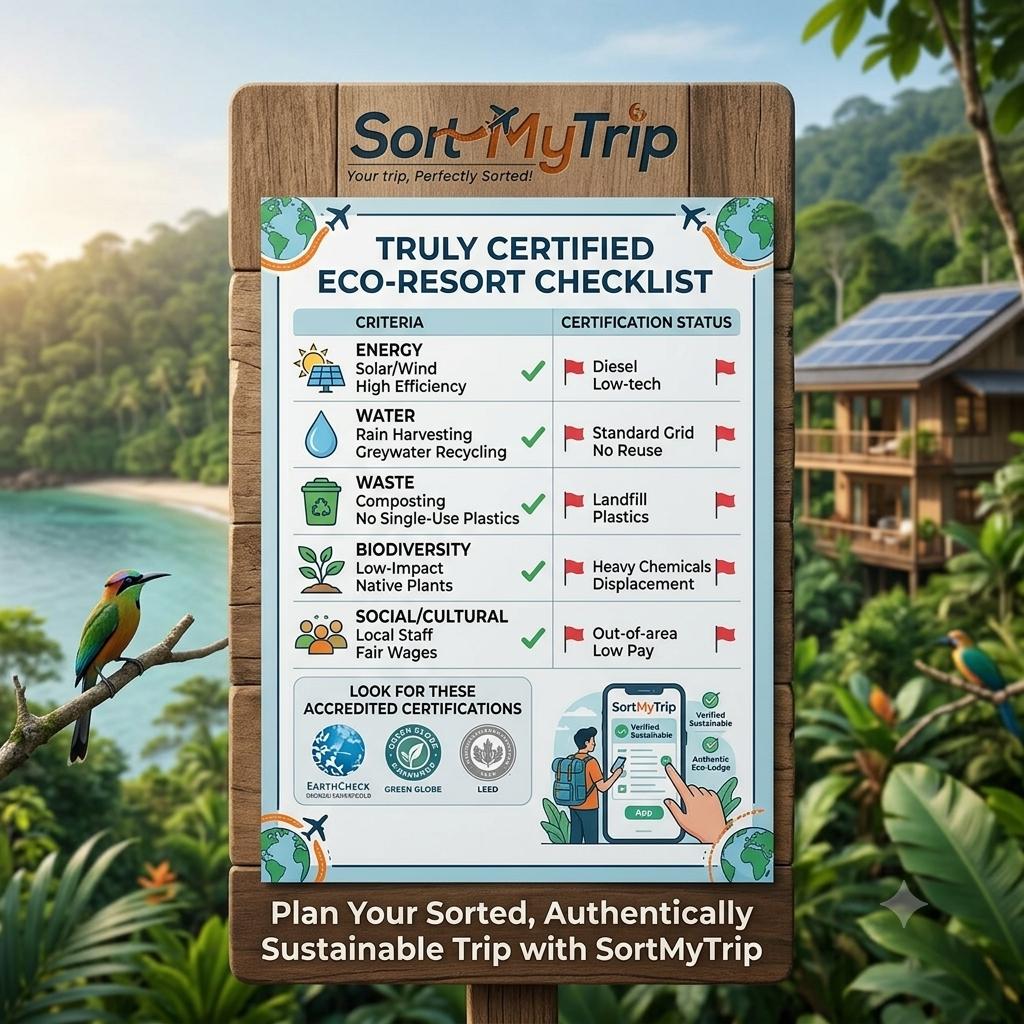
Resort Element | Authentic Eco-Resort Feature | Fake Eco-Resort (Greenwashed) Sign
Certifications | Third-party accredited seals (EarthCheck, Green Globe, LEED) | Self-made badges or paid membership logos with no clear standards
Energy Source | On-site solar arrays, wind turbines, or smart grid energy savings | 100% conventional grid or heavy diesel generator usage with no offset
Water Policy | Rainwater harvesting, greywater recycling, low-flow systems | Standard high-consumption fixtures with a basic reuse your towel sign
Plastic Usage | Zero single-use plastics; glass bottles and bulk dispensers | Individual plastic water bottles and miniature plastic toiletry tubes
Landscaping | Native plant species left to grow naturally; zero chemicals | Manicured exotic lawns requiring heavy chemical fertilizers and pesticide sprays
Staffing | Local community members hired across all management tiers | Local staff restricted to basic manual labor; outside management teams
Planning Your Sustainable Escape with Sortmytrip
Navigating the nuances of sustainable travel does not mean you have to spend days cross-referencing global certification databases or auditing a hotel’s plumbing blueprints. The most direct path to a genuinely responsible vacation is using a platform that simplifies the entire evaluation process.
With Sortmytrip, finding verified, high-quality, and ethical accommodation is completely streamlined. The platform filters out the noise of vague marketing buzzwords, allowing you to discover properties that balance luxury and comfort with verifiable environmental and social responsibility. Instead of worrying about hidden environmental costs, you can plan your itinerary with total peace of mind.
Sortmytrip connects you to carefully vetted accommodations, eco-conscious transportation routes, and authentic local experiences that protect the destinations you visit. The platform is designed to handle the logistical complexities of your journey transparently, ensuring that your travel budget directly supports genuine green initiatives and local economies.
Whether you are dreaming of a solar-powered rainforest lodge, a LEED-certified coastal retreat, or a mountain eco-resort committed to zero-waste principles, let clarity and authenticity define your next adventure. Head over to Sortmytrip today, map out your sustainable journey, and step into a world of travel that is perfectly sorted, ethically sound, and completely unforgettable.